Aqueous Film Forming Foam (AFFF) Lawsuit
Aqueous Film-Forming Foam (AFFF) lawsuits claim firefighters, paramedics, first responders and others developed cancer and other serious health problems after exposure to toxic PFAS chemicals in the firefighting foam or contaminated groundwater. 3M, DuPont and other AFFF manufacturers are defendants in the litigation.

THIS IS AN ACTIVE LAW SUIT
⚠️
AFFF Lawsuit Facts
Aqueous Film Forming Foam (AFFF) Lawsuit
As of June 2024, our legal partners are accepting AFFF lawsuits, and 9,198 lawsuits are pending in multidistrict litigation in MDL 2873 in South Carolina.
We’re dedicated to providing firefighters, military personnel, first responders and others exposed to AFFF with the latest litigation developments and legal resources. We obtain this information from court documents and lawyers litigating claims related to PFAS, cancer and other health risks.
Timeline of AFFF Litigation
- Last month, we said we were hopeful that plaintiffs' individual injury claims may be moving forward after states and public water systems had enough of their claims settled. Well, it looks like injury cases in the MDL are starting to make more progress.
- Defendants and plaintiffs proposed a case management order to determine the process for selecting cases for the initial personal injury bellwether test trials. In our experience reporting on these cases, this means discovery will likely continue throughout the rest of the year, and a trial could hopefully happen in 2025.
- The state of Indiana filed a lawsuit, 73D01-2404-PL-000009, in Shelby County Superior Court against 3M, DuPont and other AFFF manufacturers for polluting state groundwater and posing health risks to residents. This is yet another government lawsuit against 3M, DuPont and various other AFFF manufacturers. So far, our research has shown that billions have been paid in settlements, so Indiana’s lawsuit may likely settle as well.
- In fact, this month we see that Tyco Fire Products agreed to a $750 million settlement to resolve claims by public water systems that the company’s fire-fighting foams polluted the water supplies. Plaintiffs’ attorney Paul Napoli said the settlement was “critical to protecting our nation’s drinking water supplies.”
- You’re probably wondering about news on individual personal injury settlements, and so are we. Lawyers say that these big settlements for public water systems and government entities may be winding down, and this will hopefully make way for plaintiff injury cases to move forward.
- Regina Brown filed a lawsuit in the MDL against 3M, DuPont and other chemical companies in South Carolina federal court. Brown’s lawsuit alleged she was exposed to toxic chemicals from the defendants’ AFFF products through polluted groundwater, leading her to develop kidney cancer and surgery to remove her kidney.
- Lawyers who have been appointed to a leadership role in the AFFF nationwide litigation told us that plaintiffs have claimed other cancers in lawsuits such as prostate cancer, testicular cancer and liver cancer.
- The federal court approved DuPont’s $1.185 billion settlement resolving claims from public water systems over PFAS contamination. The settlement involves about 14,000 public water systems and 94% of plaintiffs chose to participate, according to the court's order.
- Plaintiffs’ attorney Scott Summy called the settlement “an important step toward protecting the health and safety of all Americans.” He also thanked DuPont for being proactive. We hope DuPont is as proactive when it comes to any potential future settlements for firefighters, first responders and others who claim cancer from AFFF exposure.
Lawyers put forth a bellwether trial pool of 25 cases. Injuries claimed in cases include kidney cancer, testicular cancer, hypothyroidism and ulcerative colitis. This brings us another step closer to future bellwether test trial dates. Why is this important to plaintiffs? Bellwether test trials are important because they often help inform both sides about potential settlement and case values.
Why Are People Filing AFFF Lawsuits?
Individuals and families affected by cancer and other serious health risks of AFFF exposure are filing lawsuits for compensation for physical, financial and emotional damages and suffering.
AFFF lawsuits allege manufacturers including 3M and DuPont knew their AFFF products could pollute water supplies, causing cancer and other health problems, according to our analysis of court documents.
“For more than half a century, the major manufacturers of aqueous film forming foam (“AFFF”) have knowingly polluted the State of Connecticut with everlasting toxic chemicals, contaminated the blood of its residents, and conspired to conceal the evidence to perpetuate their toxic trade in violation of state and federal law.”
──── Connecticut v. 3M et al.
One such document, the complaint in Connecticut v. 3M et al., said defendants knew as early as the 1950s of the toxic and persistent nature of AFFF. In our experience, this allegation along with the allegation that defendants didn’t warn the public of the dangers are common in injury cases.
“For more than half a century, the major manufacturers of aqueous film forming foam (“AFFF”) have knowingly polluted the State of Connecticut with everlasting toxic chemicals, contaminated the blood of its residents, and conspired to conceal the evidence to perpetuate their toxic trade in violation of state and federal law,” the state of Connecticut said in its complaint.
Occupations Most at Risk for AFFF Exposure
People in certain occupations such as firefighters and military personnel are at increased risk of AFFF exposure and may qualify for compensation if they’ve developed certain cancers or health problems.
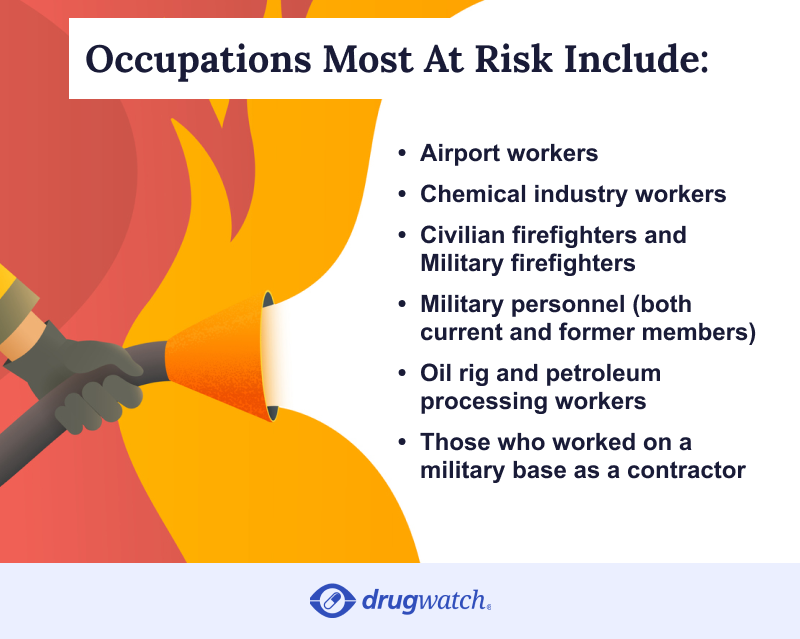
Occupations most at risk include:
- Airport workers
- Chemical industry workers
- Civilian firefighters and Military firefighters
- Military personnel (both current and former members)
- Oil rig and petroleum processing workers
- Those who worked on a military base as a contractor
We analyzed the lawsuit 2:22-cv-02568-RMG of firefighter Gary Flook and his wife, Linda Flook.
The Flooks’ lawsuit is a part of the South Carolina MDL. Gary was exposed to AFFF as a firefighter in the U.S. Air Force and as a volunteer firefighter in Indiana for many years and was never warned that the chemicals were toxic or could cause cancer. His complaint claimed that his exposure to AFFF led him to develop testicular cancer and undergo an orchiectomy as well as chemotherapy.

It’s important to note that anyone can be exposed to AFFF, especially if they live near a military base, airport or other facility that uses AFFF. We’ve already seen in studies and lawsuits that it can seep into groundwater through chemical spills and enter drinking water supplies.
Who Qualifies for an AFFF Lawsuit?
People exposed to fire-fighting foam over decades, including those who lived or worked on military bases, are among those who qualify for an AFFF lawsuit, according to lawyers tasked with investigating and prosecuting AFFF claims.
Injuries in AFFF lawsuits include:
- Kidney cancer
- Testicular cancer
- Liver cancer
- Thyroid cancer
- Thyroid disease (i.e., hyperthyroidism or hypothyroidism)
- Ulcerative colitis
- Pre-eclampsia (pregnancy-induced hypertension)
If you live near a military base, were exposed to PFAS from groundwater polluted by AFFF spills and developed one of the conditions listed above, you may also qualify. Only an attorney can tell you for sure if you qualify, so make sure to contact one right away.
How To Find an AFFF Lawyer
The easiest way to locate an AFFF lawyer is by signing up for a free case evaluation on this page. You’ll be connected with our legal partners who will evaluate your case for free.
HS and SS partners with United Tort Group. The firm has extensive experience handling toxic torts, such as Camp Lejeune water contamination and asbestos and mesothelioma.
“At The United Tort Group along with our partner law firms, we are actively taking on AFFF exposure cases and representing clients from a wide range of backgrounds, including military veterans, military firefighters, civilian firefighters, and private citizens,” according to the firm’s website.
You can also search the internet for qualified law firms. We recommend asking the law firms about their track record handling large complex environmental litigations and toxic torts and specifically about their involvement in AFFF litigation. Make sure to ask about their settlement and jury verdict track records.
Many law firms, evaluate toxic tort injury cases for free and let people know if they qualify to file a lawsuit. After that, it’s up to you to decide whether you want to hire the firm. It doesn’t become official until you sign the contract, or retainer agreement, to hire the firm.
The information on this website is proprietary and protected. It is not a substitute for advice, diagnosis, treatment and other oversight responsibilities for disease processes by a credentialed physician. Any unauthorized or illegal use, copying or dissemination will be prosecuted. Please read our disclaimer for more information about our website.
HSandss.in partners with law firms. This website and its content may qualify as attorney advertising. Prior results do not predict a similar outcome. For more information, visit our partners page.
© 2024 HSandss.in Privacy Policy / Advertising Disclosure /DO NOT SELL MY INFO